
Turbomachinery Heritage

From prime movers to
complex packaged systems.

Steam turbines and gas turbines grew from different engineering problems, different working fluids, and different cycles. Together, the Rankine and Brayton families now sit at the heart of many of the complex turbomachinery packages used in power generation and process industries.

How turbomachinery shaped the modern world

Few machines have done more to define modern industry than the turbine. By converting heat and pressure into continuous rotating power at large scale, steam and gas turbines moved ships and aircraft, energized national grids, and drove the compression at the core of the process world. The three areas below show where this technology has had the broadest reach.

Power generation

Turbines are the backbone of electricity supply. Steam turbines anchor central power stations and convert reactor heat in nuclear plants, while gas turbines provide fast, flexible grid-scale generation. In combined-cycle and cogeneration plants the two cycles work together, recovering exhaust heat to lift overall efficiency and deliver both power and process steam from a single fuel input.
Process industries

Across refining, petrochemicals, and gas handling, turbomachinery drives the compression that keeps continuous processes running. Centrifugal and axial compressors, often turbine-driven, move and pressurize gas through process trains, and the same machinery underpins large LNG liquefaction and refrigeration duties where steady, high-power mechanical drive is essential.

Transportation

The turbine reshaped how the world moves. Marine steam and gas turbines powered fast naval and commercial vessels, the aviation gas turbine made sustained jet flight practical, and turbine and turbocharged drive trains advanced rail and heavy industrial transport. Demands from these missions drove the materials and aerodynamics later carried into industrial machines.

The Steam Turbine

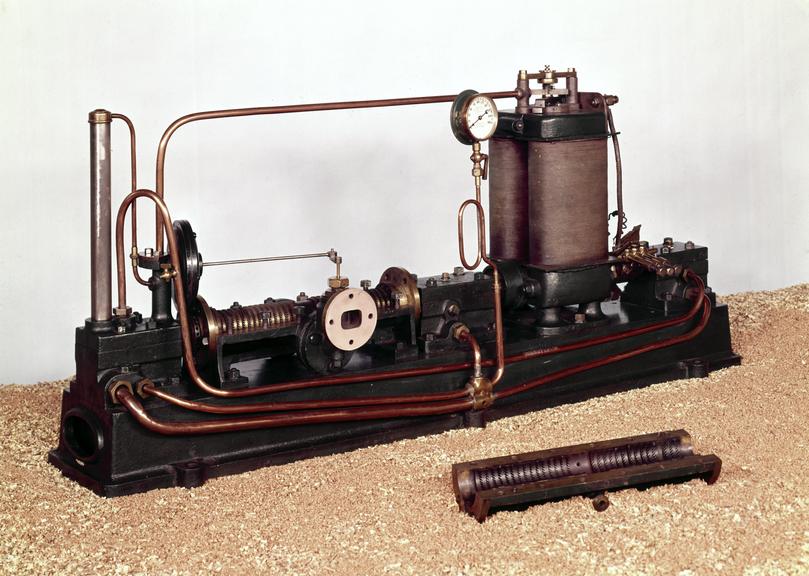
Historic Parsons steam turbine generator from 1884
Parsons' 1884 steam turbine generator (Science Museum Group Collection).
  1. 1859

    The Rankine cycle becomes the steam-power reference

    William John Macquorn Rankine described the thermodynamic cycle used as a standard for steam-power installations, where a condensable vapor is heated, expanded to produce work, condensed, and pumped back to pressure (Encyclopaedia Britannica).

  2. 1884

    Parsons makes the modern steam turbine practical

    Sir Charles Algernon Parsons developed a practical multi-stage steam turbine, using many stages in series so the steam could release energy in smaller steps instead of forcing one blade row to absorb the full drop (Encyclopaedia Britannica).

  3. 1900s

    Central stations scale the machine

    As boilers, metallurgy, governors, condensers, bearings, and generators improved, steam turbines displaced many reciprocating engines and became the prime mover of large electric power stations. The Rankine cycle remained the organizing model for pressure, temperature, enthalpy drop, heat rate, and condenser performance.

  4. Today

    Steam turbines become part of wider thermal systems

    Modern steam turbines operate in fossil, nuclear, biomass, waste-heat, cogeneration, and combined-cycle plants. In a combined cycle, exhaust heat from a gas turbine is recovered in an HRSG to feed a Rankine bottoming cycle, linking field execution directly to both thermal performance and mechanical reliability. This is where Rankine & Brayton Technical Solutions LLC brings practical field expertise to complex turbomachinery packages, supporting installation and commissioning for power generation, combined-cycle, cogeneration, and process applications.

The Gas Turbine

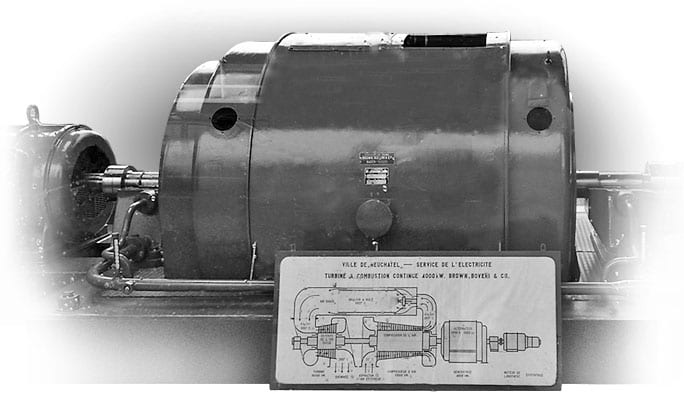
Historic 1939 Neuchatel gas turbine installation
1939 Neuchâtel gas turbine installation (POWER Magazine).
  1. 1870s

    The Brayton cycle defines continuous-flow heat addition

    The ideal Brayton cycle describes compression, constant-pressure heat addition, and expansion through a turbine. NASA explains that this cycle is used in all gas turbine engines and is a basis for predicting turbine-engine thermodynamic performance (NASA Glenn Research Center).

  2. Early 1900s

    Compressor and turbine efficiency limit early machines

    The gas turbine concept required at least a compressor, combustor, and turbine, but practical development was delayed by the difficulty of designing efficient compressors and turbines capable of producing useful net shaft work (Encyclopaedia Britannica).

  3. Mid 1900s

    Aviation accelerates the technology

    Aircraft gas turbines pushed axial compressor design, combustor stability, high-temperature materials, blade cooling, and lightweight package architecture. These same disciplines later supported aeroderivative industrial units used for power generation, compression, and process service.

  4. Today

    Heavy-duty and aeroderivative packages serve different missions

    Heavy-duty gas turbines are built for robust stationary duty, while aeroderivatives emphasize high power density, modularity, and operational flexibility. Both rely on the Brayton cycle, but their installation, auxiliary systems, package interfaces, commissioning logic, and field execution risks can be very different. This is where Rankine & Brayton Technical Solutions LLC brings practical field expertise to complex turbomachinery packages, supporting installation and commissioning for power generation, combined-cycle, cogeneration, and process applications.